A corrected alignment analysis inside a report that also preserves stale legacy text
The opening revision and revised figures use the full 772-column alignment. Later PDF pages retain an older 706-column TrimAl analysis with conflicting counts and substitution claims; those legacy values are not mixed into the results below.
How conserved is FOXP2 across selected mammals, birds, and reptiles?
FOXP2 is a transcription factor involved in motor learning and vocalization-related neural circuits. Sequence conservation can identify constrained positions, but it cannot by itself explain language or vocal learning.
Across the curated vertebrate sequence set, what are the pairwise identities, conserved and variable alignment positions, phylogenetic relationships, and candidate lineage-specific substitutions?
| Sequence set | 14 complete proteins at least 700 aa plus one 693-aa alligator partial |
|---|---|
| Alignment | MAFFT, 772 columns, no TrimAl removal for revised statistics |
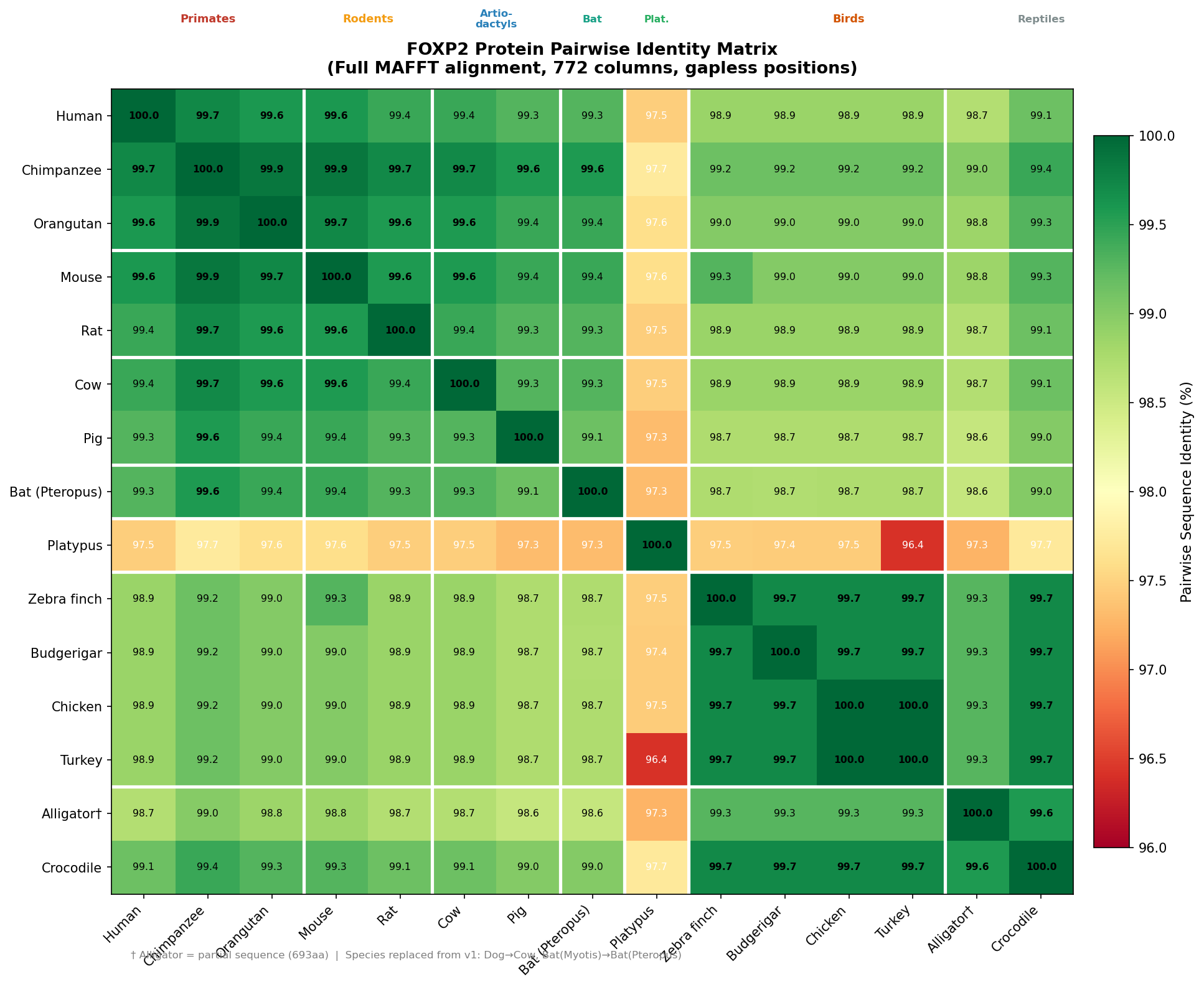
| Identity | Computed over comparable non-gap aligned positions |
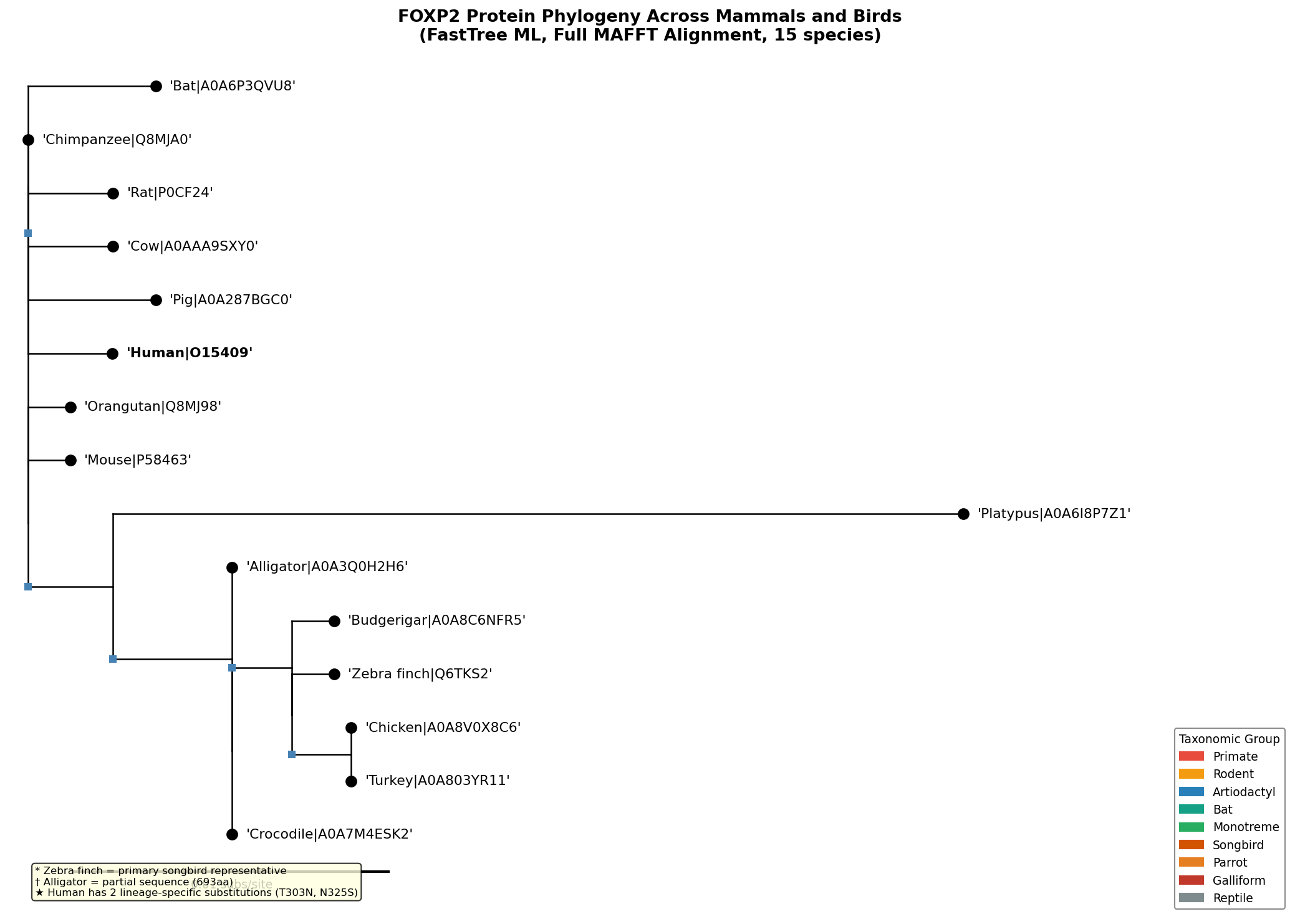
| Tree | Approximate maximum likelihood |
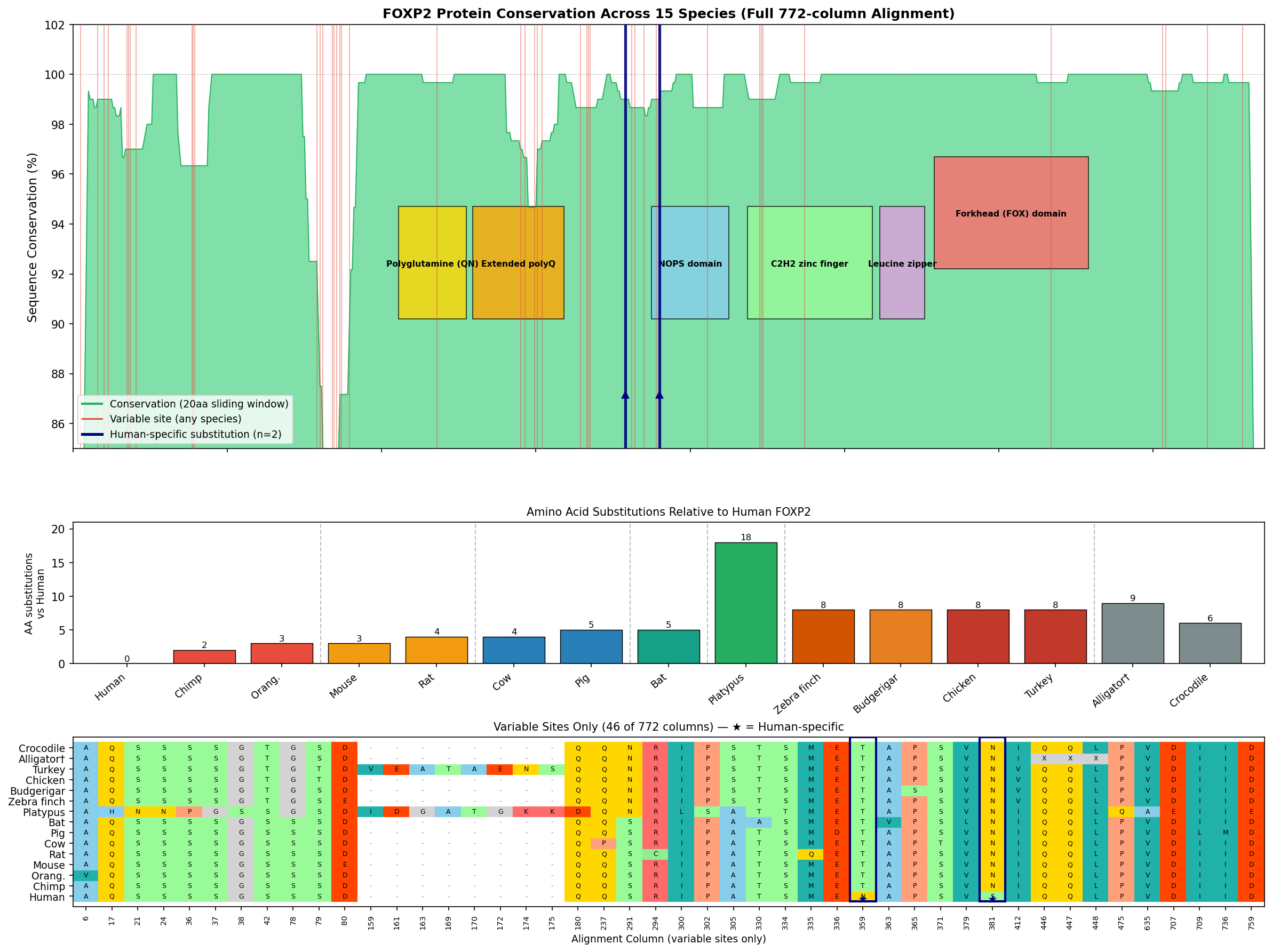
| Human-site review | T303N and N325S checked across the revised set |
Curate sequences, align, quantify conservation, review substitutions, and infer a tree
FOXP2 is highly conserved across the selected vertebrates
726 of 772 alignment columns were conserved in the revised analysis; 46 were variable.
99.72% pairwise identity in the revised matrix.
98.87% pairwise identity despite deep evolutionary distance.
T303N and N325S were reported as human-specific within the revised sequence set.
Report conflicts and sequence scope limit biological inference
- The PDF contains a revised opening analysis and a stale legacy body with a 706-column TrimAl alignment and 86 variable columns.
- The legacy body says N325S is shared with dog, whereas the revised review reports both T303N and N325S as human-specific in the selected set.
- The alligator sequence is partial; incomplete sequences and isoform choice can affect identities and alignment columns.
- The selected taxa are not exhaustive and some expected vocal-learning lineages are absent.
- The approximate tree lacks the bootstrap analysis expected for publication-quality phylogenetics.
- High identity or a lineage-specific substitution does not establish a causal mechanism for human language or bird song.
Only the revised full-alignment results are presented as current. The contradictory legacy text remains visible in the PDF and should be removed in a future clean report.
Artifacts recorded for the revised analysis
revised_sequence_set.fastaCurated 15-sequence inputfoxp2_alignment_full.fastaFull 772-column MAFFT alignmentidentity_matrix_v2.tsvRecomputed pairwise identitieshuman_specific_review.tsvT303N and N325S cross-species reviewfig1–fig4Revised tree, identity, conservation, and substitution figures