A corrected allele-specific frequency analysis with unresolved edge cases
The revised workflow replaced position-only or gene-level assumptions with position-plus-reference-and-alternate matching. Records that could not be queried or represented remain visible rather than silently treated as confirmed absences.
How often are Rett-associated pathogenic ClinVar alleles observed in gnomAD?
The revised session assembled 586 unique pathogenic or likely pathogenic ClinVar variants across eight Rett-associated genes or loci, then matched queryable alleles to gnomAD by genomic coordinates and alleles.
For each Rett-associated ClinVar allele, is the exact variant absent, ultra-rare, rare, or more common in the queried gnomAD data?
| ClinVar criteria | Pathogenic or likely pathogenic; Rett syndrome |
|---|---|
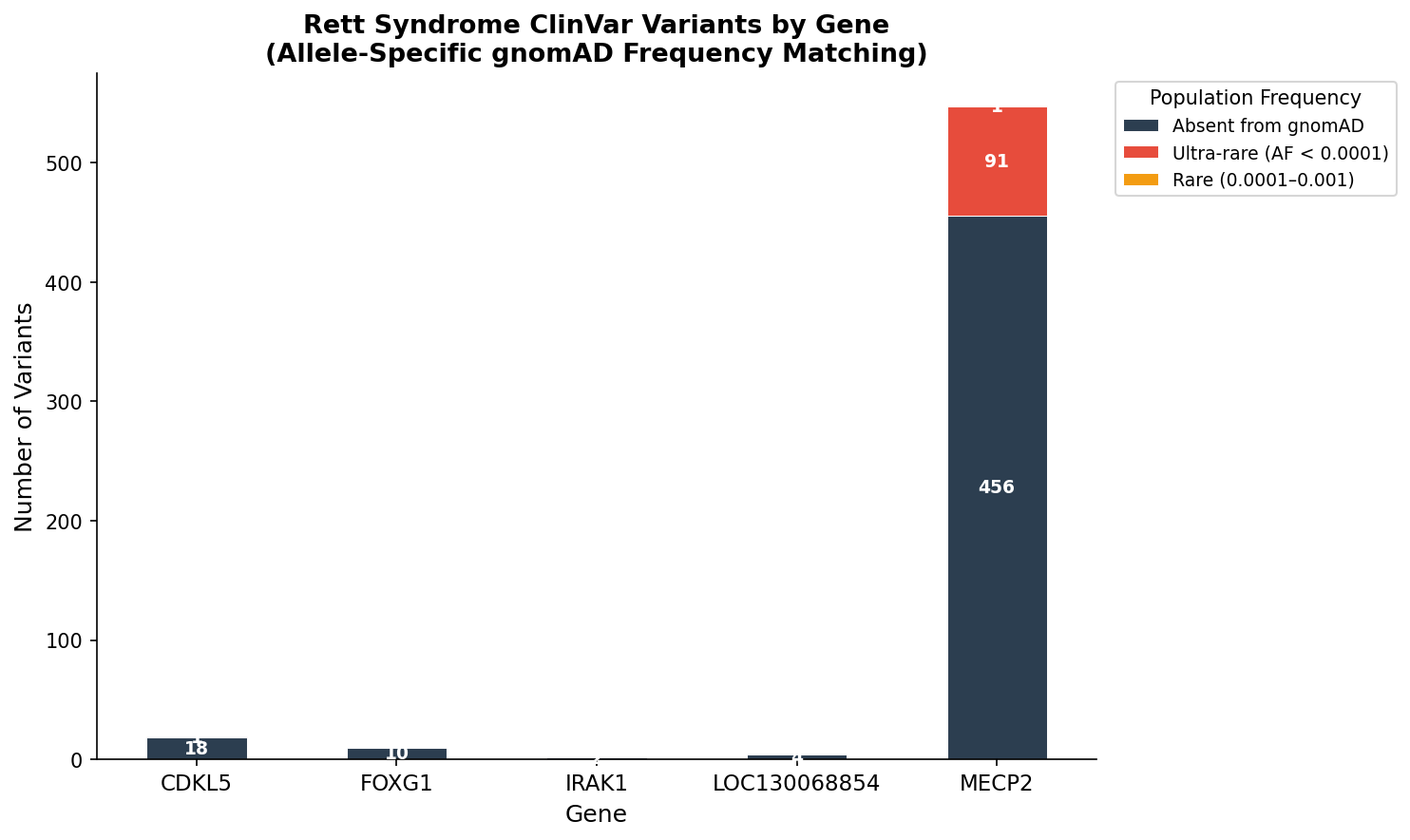
| Gene distribution | 548 MECP2, 19 CDKL5, 10 FOXG1, 9 other |
| Frequency bins | Absent, ultra-rare, rare, and more common |
| Revised method | Coordinate and REF/ALT allele matching |
ClinVar retrieval, normalization, allele matching, and edge-case review
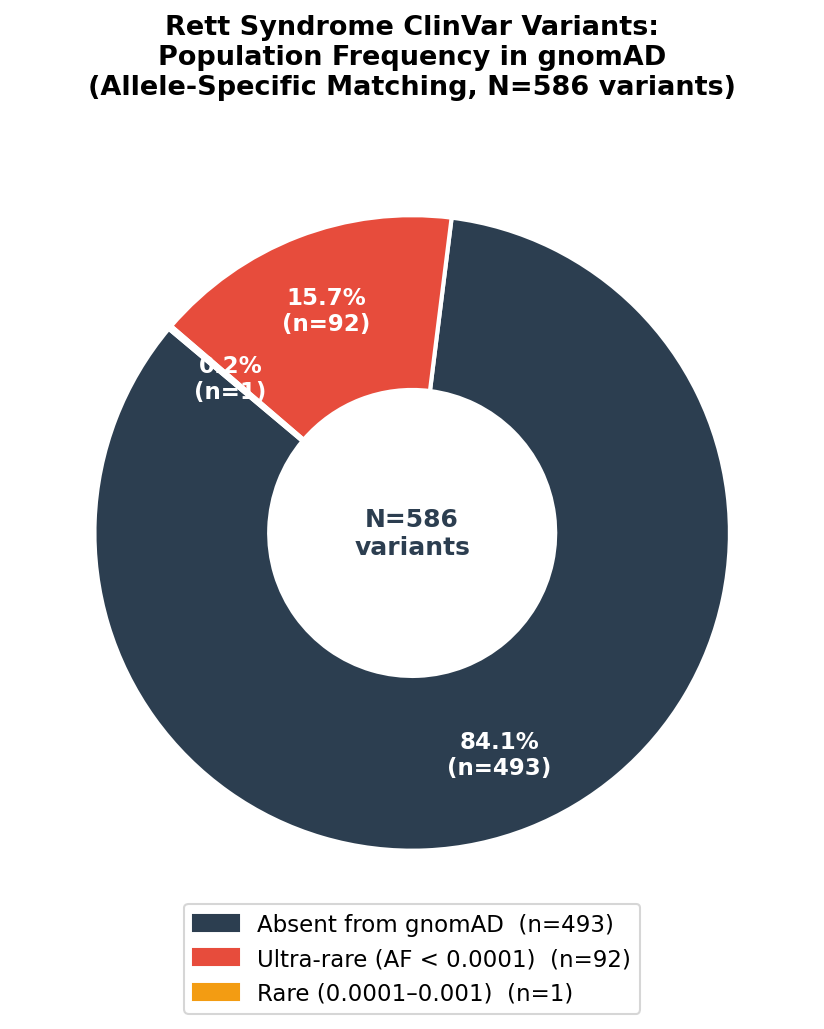
585 of 586 variants were classified absent or ultra-rare
84.1% of the 586 variants were classified as absent from matched gnomAD records.
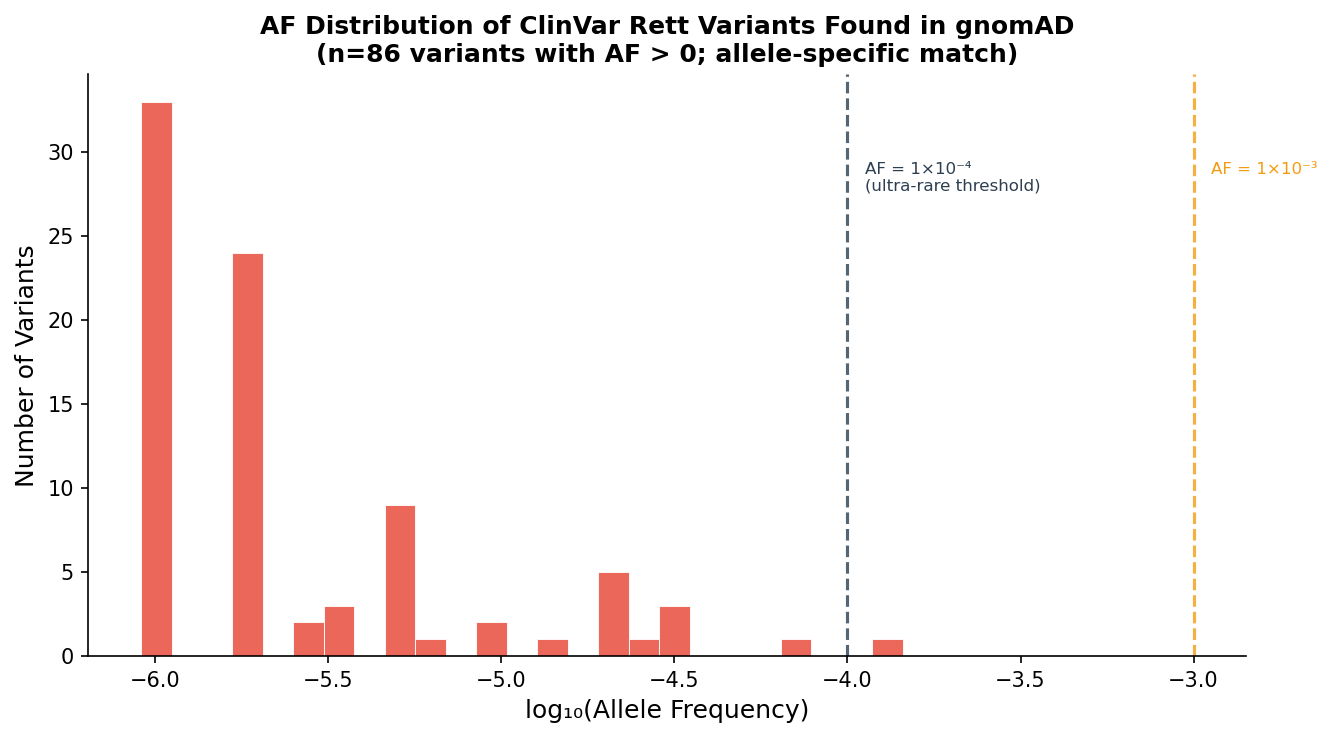
15.7% had allele frequency below 1 × 10⁻⁴; 81 were below 1 × 10⁻⁵.
MECP2 c.1183_1210del had AF 1.45 × 10⁻⁴.
585 of 586 variants, or 99.8%, were absent or ultra-rare.
Some absences are unresolved rather than confirmed
- Nine variants from minor loci could not be retrieved through the gnomAD API and were classified absent by default; they require manual verification.
- Five copy-number variants are not matchable to the short-variant dataset and should be checked in gnomAD-SV.
- Fallback indel normalization may miss equivalent left-normalized representations.
- Chromosome X frequencies use combined population values and may obscure sex-specific context.
- ClinVar classifications and gnomAD datasets change over time.
- Population frequency does not determine pathogenicity or patient-level penetrance.
The corrected aggregate is useful for prioritization, but the unresolved API records and structural variants should not be described as confirmed absent without manual and gnomAD-SV review.
Artifacts recorded in the Pipette session
rett_clinvar_variants.csvClinVar source setrett_queryable_variants.csvCoordinate-ready allelesrett_variants_gnomad_allele_matched.csvRevised match resultsgnomad_rett_genes.jsongnomAD response datafig1–fig4Revised frequency figures