Papers reported10
scRNA-seq7 / 10
Spatial3 / 10
Citation registryMissing
What themes does the session report identify across recent lung cancer TME papers?
The generated report summarizes ten records around single-cell and spatial studies of the lung cancer tumor microenvironment. Because it omits the record-level sources, this page attributes all counts and themes to the report itself.
- Scope
- Lung cancer tumor microenvironment
- Reported methods
- 7 scRNA-seq and 3 spatial studies
- Reported focus
- 8 immune-microenvironment studies
- Recorded runtime
- 7.2 seconds
Retrieval, categorization, synthesis, and visualization
Search literatureThe session reports querying PubMed for ten recent papers, but does not preserve the exact search string.
Classify studiesGrouped records by method, cell type, immune focus, and reported therapeutic relevance.
Synthesize themesSummarized immune exhaustion, macrophage programs, cell communication, and target discovery.
Generate outputsCreated a narrative report, summary table, and overview figures.
Immune-cell states dominate the generated synthesis
T cells
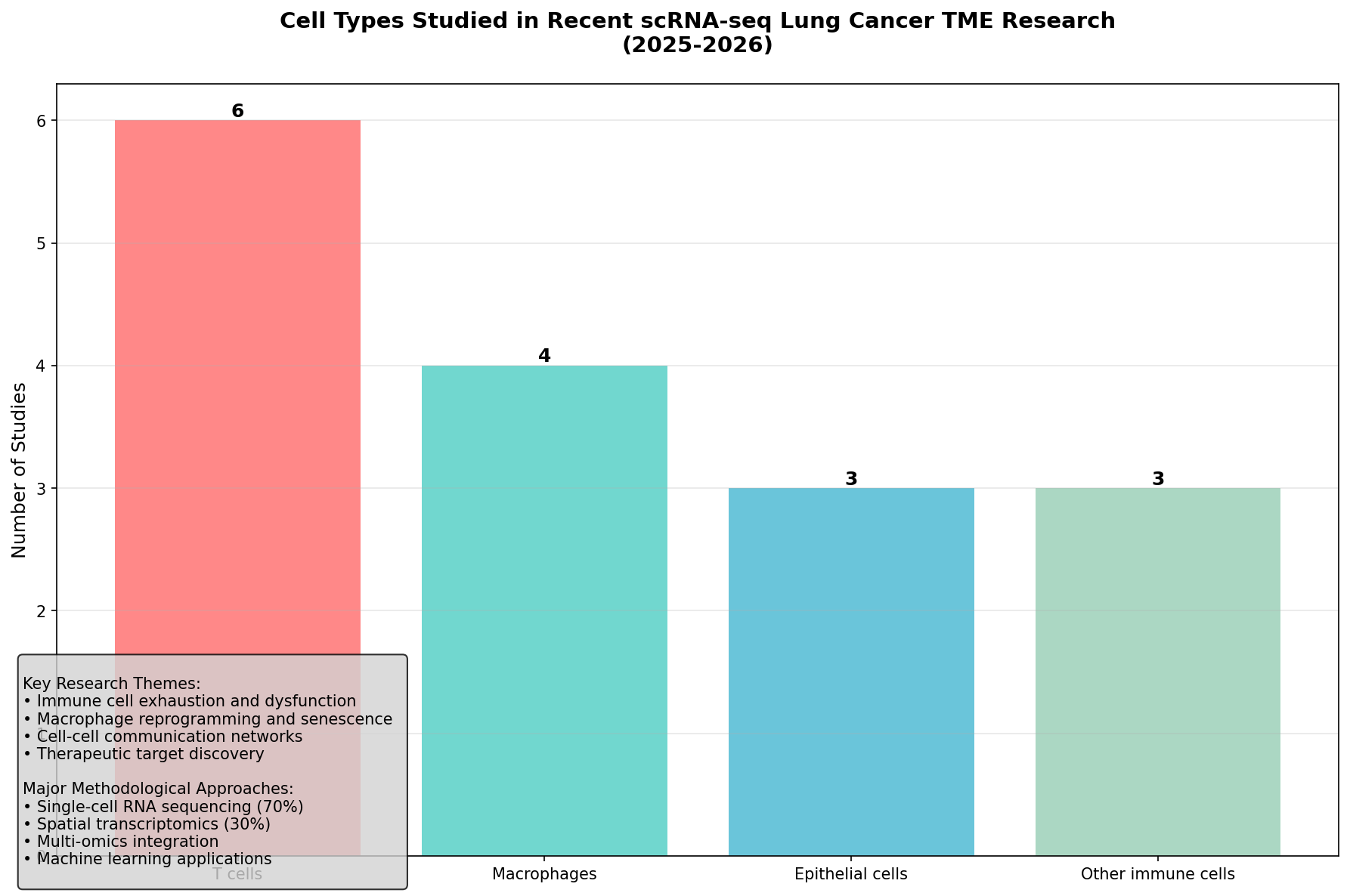
Six of ten papers were categorized as containing T-cell findings, including exhaustion-related themes.
Macrophages
Four of ten were categorized around macrophage biology and reprogramming.
Epithelial cells
Three of ten were categorized as addressing epithelial-cell states.
Immunotherapy
The report states that six papers contained immunotherapy-related findings.
This is not a reproducible or source-validated literature review
- The PDF does not list titles, authors, journals, PMIDs, links, or a record-level citation registry.
- The exact PubMed query, filters, result ordering, inclusion criteria, and exclusion criteria are absent.
- The report says “Time Period 2022–2024,” describes studies from 2025–2026, and labels a figure 2025–2026.
- Named biomarkers and biological conclusions cannot be traced to primary sources from the supplied artifacts.
- No duplicate screening, quality appraisal, or systematic-review protocol is documented.
Confidence boundary
Treat the page as a demonstration of thematic synthesis output. Before scientific reuse, rerun the search and retain a complete, verifiable citation registry.
Artifacts named in the session
comprehensive_literature_report.mdGenerated narrative synthesisstudy_summary_table.csvGenerated study categoriesliterature_analysis_summary.pngSummary figurepubmed_analysis_overview.pngOverview figurepubmed_detailed_analysis.pngDetailed figureOriginal session report8-page PDF with report-derived counts, figures, and the provenance limitations documented above.
Download PDF